

SweetNight CoolNest Memory Foam Review
How we reviewed this: This review is built from SweetNight’s published specifications and the hands-on findings of independent test labs including Sleep Foundation, NapLab, Sleep Junkie, and GoodBed, cross-checked against buyer feedback. Firmness, layer construction, and certification details reflect the current CoolNest Memory Foam line as of July 2026. Prices move with SweetNight’s frequent sales – always confirm the live price before buying.
Scorecard
Pricing & terms
| Queen price | $329.99 |
|---|---|
| Twin price | |
| King price | $429.99 |
| Trial | 100 nights (30-night break-in recommended) |
| Warranty | 10 years limited |
| Weight capacity | 551 lb |
Who the CoolNest Memory Foam is for
The clearest way to decide whether this mattress fits you is to match it to how you sleep and what you weigh, because an all-foam bed behaves very differently across body types.
It’s a strong match if you are:
- A hot sleeper on a budget. Cooling is the CoolNest’s headline strength. The gel-infused memory foam, phase-change top layer, and heavily vented cover work together to keep the surface cooler than standard memory foam, which normally traps heat.
- Part of a couple, or a light sleeper. Motion isolation is the single best-scoring attribute here. If a partner’s movement usually wakes you, this is exactly the kind of bed built to absorb it.
- A back sleeper of light-to-average weight. The zoned support base cradles the lumbar region without letting the hips sag, which is what back sleepers need for neutral spinal alignment.
Look elsewhere if you are:
- A strict side sleeper who wants deep pressure relief. Depending on the profile you choose, the CoolNest can read firmer than a plush side-sleeper bed. Heavier side sleepers in particular may want more give at the shoulder.
- A heavier sleeper who needs maximum support. This is an all-foam bed with no coils. Sleepers well over 230 lb generally get better long-term support from a hybrid with a reinforced coil core.
- Someone who sits or sleeps right at the edge. Edge support is the CoolNest’s weakest measured category (more on that below).
How firm is it, really?
This is the most misunderstood thing about the CoolNest, so it’s worth being precise. SweetNight markets it as a “medium,” but the actual firmness depends on which profile (height) you buy, and independent reviewers land in slightly different places.
The pattern that holds across testing: firmness decreases as the mattress gets taller. The extra foam in the thicker models adds cushioning, so the surface feels progressively softer. As a general guide:
- 12-inch: the firmest option, closer to a true medium-firm (around 6/10). The most supportive pick, and the one back and stomach sleepers tend to prefer.
- 14-inch: a balanced medium (around 5/10). The middle-of-the-road choice for combination sleepers.
- 16-inch: the softest and most cushioning (around 4/10, medium-soft), which lets lighter side sleepers sink in more.
Your body weight shifts this too. Lighter sleepers don’t press into the deeper layers, so any given profile feels firmer to them; heavier sleepers compress further and experience the same bed as softer. If you’re between two profiles, choosing based on your primary sleeping position is usually the safer bet than chasing an exact number.
Inside the mattress: layer-by-layer construction
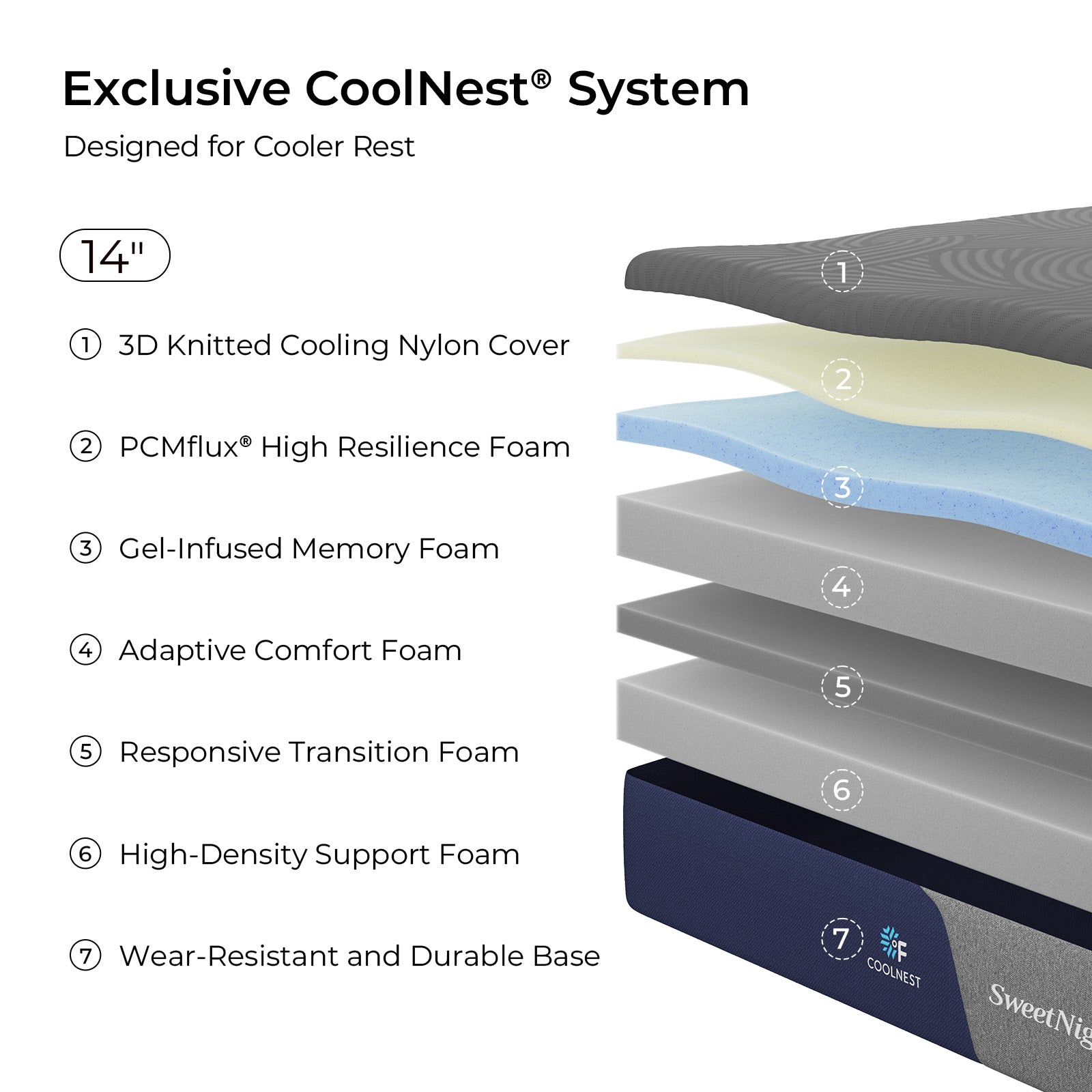
The CoolNest Memory Foam is an all-foam build – no coils, no latex, and (importantly) no fiberglass. From the top surface down, it stacks purpose-built layers, each doing a specific job:
- CoolNest cover: a 3D-woven fabric with over 10,000 micro-vents, engineered to be cool to the touch and to move air and moisture away from the surface.
- PCMflux high-resilience foam: the top comfort layer, infused with phase-change material (PCM). PCM absorbs body heat, and this layer also responds faster than traditional memory foam – which is why the bed feels less “stuck” when you change positions.
- Gel-infused memory foam: the pressure-relief workhorse. It contours to your body and draws heat away, adding both cushioning and cooling.
- Ocean memory foam (contouring layer): a transitional contouring layer that deepens the body-cradling before you reach the firmer support below.
- Transition comfort foam: bridges the soft comfort layers and the firm base so you don’t feel an abrupt change as you settle in.
- 5-zone support base foam: the structural foundation. It’s cut into five zones of differing firmness so that heavier areas (hips, shoulders) get more support while lighter areas (head, feet) get gentle cushioning. This zoning is what keeps the spine aligned on an all-foam bed.
All foams are CertiPUR-US certified (free of the worst chemical offenders) and the cover meets the OEKO-TEX Standard 100 for skin-contact safety. SweetNight also notes the CoolNest is endorsed by the American Chiropractic Association, which speaks to the zoned support’s spinal-alignment design.
Cooling performance: does it live up to the name?
Cooling is where the CoolNest earns its keep. Memory foam has a well-earned reputation for sleeping hot, because dense foam traps body heat. SweetNight attacks that problem from three directions at once, and independent testing confirms it works better than most all-foam beds.
The three cooling mechanisms:
- The vented cover physically feels cool to the touch and lets air move, rather than sealing heat against your skin.
- Phase-change material in the PCMflux top layer actively absorbs heat, delaying the warm-up that plagues ordinary foam.
- Gel infusion in the memory foam conducts heat away from your body instead of letting it pool.
Reviewers who put the bed through hands-on temperature testing rated cooling around 9/10, and consistently described the surface as noticeably cooler than standard memory foam. It’s worth setting expectations honestly, though: passive foam cooling has limits. A gel-and-PCM foam bed delays heat buildup impressively, but a hybrid with an airflow-generating coil core will always have a ceiling advantage for the very hottest sleepers. For a foam mattress in this price range, however, the CoolNest’s cooling is genuinely a standout rather than a marketing line.
Motion isolation and edge support
Motion isolation is the CoolNest’s best single attribute. In lab testing it earned a perfect 10/10, with testers reporting that a jar placed on one side stayed motionless during vigorous movement on the other. If you sleep with a partner who tosses, turns, or gets up at different hours, this is the kind of motion containment that keeps their movement from becoming your problem. It’s a direct benefit of the all-foam construction: with no coils to transmit energy across the bed, movement stays local.
Edge support is the flip side of that same coin, and it’s the CoolNest’s weakest measured category. Reviewers landed around 7/10, describing noticeable compression when sitting on the perimeter. This is the expected limitation of an all-foam bed without reinforced edge coils. In practice it means two things: you may feel like you could roll off if you sleep right at the very edge, and the usable sleeping surface is effectively a little smaller than the mattress’s footprint. For couples trying to maximize every inch of a shared bed, factor this in.
The honest weak spots
No mattress is right for everyone, and a genuinely useful review has to be straight about the compromises. Here are the CoolNest Memory Foam’s real limitations:
- Edge support. As covered above, the all-foam perimeter compresses under concentrated weight. Expected for the category, but a real consideration for edge sleepers.
- Responsiveness for very active sleepers. The PCMflux top helps, but this is still a memory-foam bed at heart. Combination sleepers who change positions constantly all night may feel a slight lag compared with a hybrid or latex bed.
- Long-term durability is the open question. Value-focused foam beds balance cost against foam density, and lower-density foams are more prone to softening and body impressions over time. SweetNight’s warranty covers sagging greater than 1.5 inches, which tells you the threshold they’ll stand behind – but as with most budget foam, expect it to be a solid several-year mattress rather than a decades-long heirloom.
- Limited small sizes. The line starts at Full – there’s no Twin or Twin XL – so it won’t suit a child’s room or a narrow guest space.
Trial, warranty, and what’s protected
SweetNight backs the CoolNest Memory Foam with a 100-night sleep trial and a 10-year limited warranty. A few details worth knowing before you buy:
- The 30-night break-in matters. SweetNight (like most foam brands) asks you to sleep on it at least 30 nights before judging, because foam needs time to settle and your body needs time to adjust. Don’t make a final call in the first week.
- The warranty’s sag threshold is 1.5 inches. That’s the depth of permanent body impression that has to form before a warranty claim is covered – a useful number to know, since impressions are the most common long-term foam complaint.
- Returns are genuinely free during the trial. SweetNight arranges pickup and a full refund if it isn’t working out, and notes that returned mattresses are donated to local charities.
CoolNest Memory Foam vs. CoolNest Hybrid
The most common cross-shopping question is whether to step up to the CoolNest Hybrid instead. The two share the same cooling comfort layers – same cover, same PCM and gel foams – so the difference comes down to what’s underneath.
- Choose the Memory Foam if your priorities are the lowest price, the deepest motion isolation, and a closer body-hugging feel. It’s the better pick for couples focused on undisturbed sleep and for lighter sleepers.
- Step up to the Hybrid if you want more support and airflow from a coil core, better edge support, or you’re a heavier sleeper. The coils add responsiveness and a cooler-running structure, at a higher price.
If you like everything about the CoolNest feel but wish it had a little more support and structure, the Hybrid is the natural upgrade. If cooling foam with best-in-class motion isolation at the lowest entry price is the goal, the Memory Foam is the one.
The bottom line
The SweetNight CoolNest Memory Foam does a small number of things unusually well for its price: it sleeps cool, it isolates motion almost completely, and its zoned base keeps the spine aligned for back sleepers. It asks you to accept the standard all-foam compromises in return – softer edges, a bit of responsiveness lag for restless sleepers, and the durability question that comes with budget foam.
For a hot sleeper, a light sleeper, or a couple shopping on a budget, that’s an easy trade to make, and the CoolNest is one of the best values in the category. For strict side sleepers wanting plush pressure relief, or heavier sleepers needing a robust coil core, it’s worth looking at the CoolNest Hybrid or a dedicated hybrid instead. Match it to how you actually sleep, and it delivers far more than its price suggests.
Ready to check the latest price on the SweetNight CoolNest Memory Foam?
The SweetNightCoolNest Memory Foam is one of our picks in: